
A Declaration of Digital Independence
This isn't a fight for your digital life. It's a fight for your entire life.

This year marks a major anniversary of the Declaration of Independence:
“Governments of the Industrial World ... I come from Cyberspace, the new home of Mind. On behalf of the future, I ask you of the past to leave us alone. You are not welcome among us. You have no sovereignty where we gather.”
Oh, you thought I was talking about a different declaration.
Those are the opening lines of the Declaration of the Independence of Cyberspace, written in 1996 by John Perry Barlow, a founder of the Electronic Frontier Foundation and a lyricist for the Grateful Dead. It turns thirty this year. And it was modeled on the original Declaration of Independence from 1776, which turns 250 years old today.
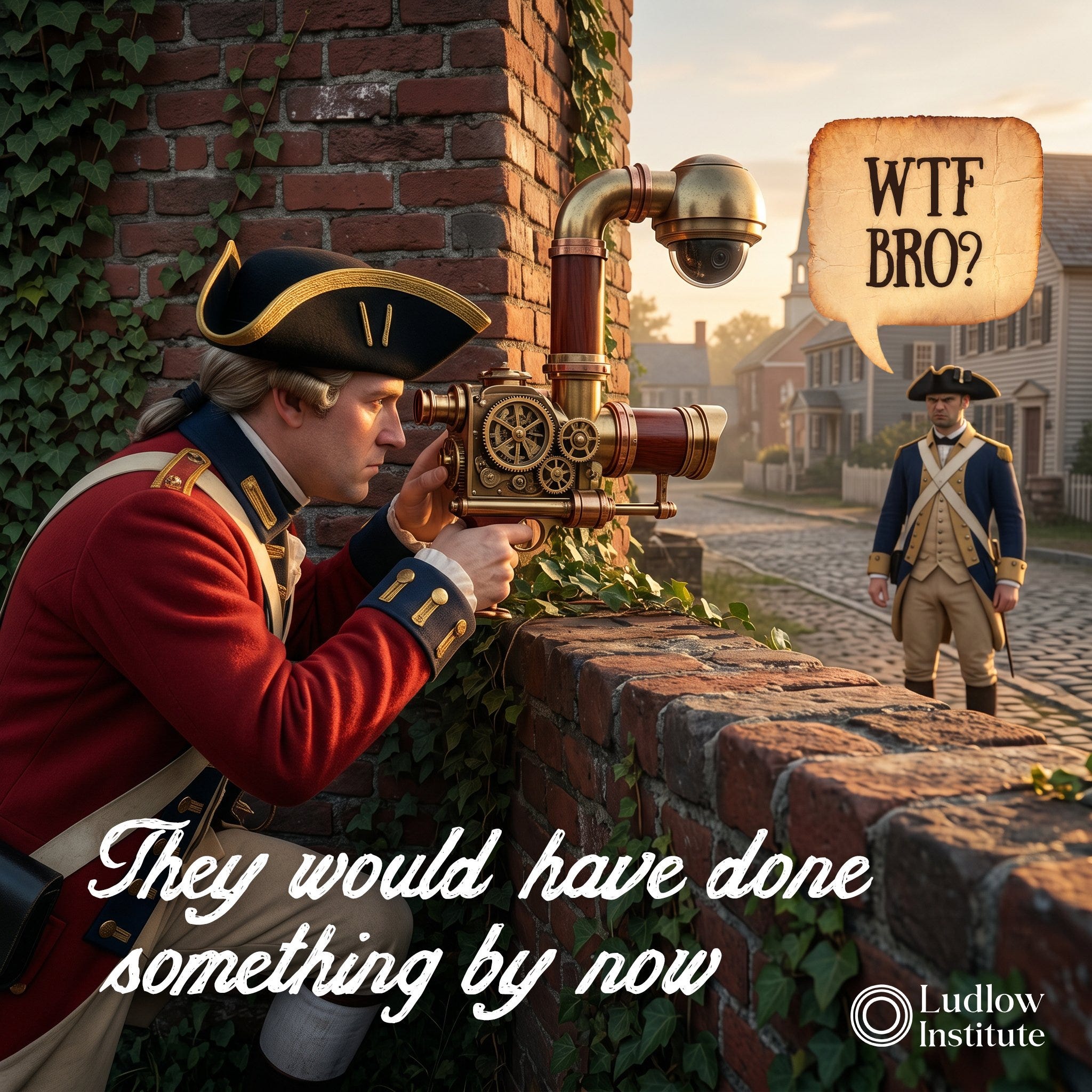
Independence is a word we hear a lot, especially around this time of year. It is worth stopping to ask what it actually means now, in an age where most of your day happens inside software and systems you cannot see and do not control.
At its core, independence means the same thing it always has. Thinking for yourself. Speaking without fear. Making your own choices about how you live, what you buy, and how you raise your kids. Owning your own mind.
In the digital age, every one of those things is harder than it used to be. Someone is always trying to shape what you see, nudge what you believe, and track what you do. Then they take control of your child’s screen and do it all to them, too. The pressure is quieter than soldiers in red coats going through your belongings or being quartered under your roof. But this invasion reaches further than any king or army ever could.
Barlow envisioned a cyberspace that was free. A place where anyone could speak, learn, build, and connect without asking permission. Instead the digital frontier got captured. By governments who want to monitor you, and by corporations who get rich turning your attention, your data, and your private life into products. The two work hand in hand now, feeding on each other.
In this article, I want to look at three things:
- The context of the original declaration
- The promise behind Barlow’s Declaration of the Independence of Cyberspace
- What kind of declaration we need today to protect our privacy, autonomy, and independence into the years to come.
Standing up in the face of digital tyranny and making a moral declaration has never been more important.
“A Tyrant is unfit to be the ruler of a free people.”
Let’s start with a recap of what was going on at the time of the original declaration, especially for those of us who are not Americans.
It is the summer of 1776, and a group of people are about to do something that, by any rational calculation, is insane. They are going to pick a fight with the most powerful empire on earth.
The Royal Navy controls the oceans. The British Army is the most battle-hardened fighting force alive. The British economy dwarfs everything around it. The reach of the Crown extends to every corner of the globe.
These people have had enough. Their lives are being run from three thousand miles away by men who have never set foot on the continent. The rules keep changing. The taxes keep coming. And if you say the wrong thing about the King, his men come knocking, going through your belongings, reading your letters, hunting for anything they can arrest you for. There is no privacy. There is no free speech. There is nowhere to hide.
Most people just put up with it. They lower their voices. They watch what they write. They accept that nothing in their home is really theirs. Because what else can you do? You are a farmer with a musket. The King has a navy. There are always people in charge in society (it’s just the way things are) and you’re not one of them.
And yet. On July 4th, 1776, fifty-six people signed their names to a document declaring that the King no longer had any legitimate authority over them.
Think about that for a moment. Most of us walk through life assuming certain things. There is a government. There has always been one. There always will be. The people in charge are in charge, and the best we can hope for is to beg them not to strip away too many of our rights.
These fifty-six signers assumed something new:
That the government works for us. That it exists to serve us, not to rule us. That its power comes only because the people choose to give it, and that the people can choose differently. We get to end it and start over if those in power begin abusing it instead of protecting our liberty.
The document says it plainly. That “whenever any Form of Government becomes destructive of these ends, it is the Right of the People to alter or to abolish it, and to institute new Government.” That when “a long train of abuses and usurpations” reveals a clear plan to force people under “absolute Despotism, it is their right, it is their duty, to throw off that government.”
That was a radical idea. It still is. It took enormous courage to face the most powerful empire in the world and say “you do not rule us anymore.” Every person who signed was signing a potential death warrant. If the revolution failed, that piece of paper became a list of traitors.
So why do it? Because submission was its own kind of death.
Some things are worth standing up for: The right to think your own thoughts. To make your own choices. To keep your private life private. To raise your own children.
They had no idea whether they would win. This is something we forget, two hundred and fifty years later, with the outcome already written into the history books. But the odds at the time were very much against them.
Which brings us to today. Our lives migrated to the digital realm. And that world is more watched and more controlled than anything before it. People tell me all the time that the fight for privacy is already lost. That surveillance is too big to beat. That it is David against Goliath, and Goliath already won. But everyone forgets how that story ends: Goliath was the favorite, and Goliath lost.
History is full of fights that could not be won, and were won anyway.
1996
But before we get into how we fight today, we have to see what we lost. Let’s go back to 1996, when the internet was still a place that belonged to no one.
In 1996 the digital world was a new frontier. It was decentralized. Nobody owned it. It ran on open protocols, which meant the rules for how information traveled were public, free, and available to anyone. Ideas moved without gatekeepers. Someone in a small town could publish something and be read on the other side of the world. Power was genuinely flattened.
Barlow and others believed the architecture of the internet made it ungovernable. That it was free by its very nature.
They were wrong. Not about the dream, but about the infrastructure.
The internet was declared independent, but its servers sat inside territory that was already captured. The physical hardware, the data centers, the cables, the routers, all lived inside jurisdictions with laws, courts, and subpoenas. The companies that grew on top of the open internet discovered that the most profitable thing they could do was gather data. Your searches. Your messages. Your location. Your purchases. Your relationships. Your fears.
Surveillance turned out to be extraordinarily valuable. To advertisers. To political campaigns. To anyone who wanted to understand you well enough to influence you. Above all, to governments. Piece by piece, we handed over the moral presumption that governments had the right to see everything about us, simply because it traveled along wires they claimed to control.
Today a handful of companies mediate almost everything that happens online. They decide what you see. They decide what gets amplified and what gets buried. They can remove you from the conversation entirely. The open internet Barlow imagined has been replaced by walled gardens run by private entities with their own interests and their own relationships with governments.
Internet freedom was not lost all at once. It went platform by platform, terms-of-service update by terms-of-service update, until one day you look around and realize this does not look like independence anymore. It looks a lot like the thing we were supposed to be free from.
Why Is Privacy An Essential Part Of Independence?
Independence means being the architect of your own life. If you are not the one who designs it, carries it out, and benefits from it, then whose life is it? Many people feel like passengers in their own lives. We are not passengers. We get to build our lives, make up our own minds, and pursue our own happiness. Privacy is what protects that.
Ask someone why they care about it and they will usually say something like, “I have nothing to hide.” As if privacy were only for people doing something wrong.
But privacy is not about hiding. It is about becoming.
Every person changes over the course of a life. We try on ideas. We embarrass ourselves. We hold beliefs we later abandon. We say things in our twenties we would never say in our fifties. That journey, from who you are to who you are going to be, needs a private space to happen in. A place where you can be wrong before you are right. Where you can think a thought without it being logged, scored, and used against you five years later.
Without that space you cannot grow. Your digital self is etched in stone, and it will always be held over you. You cannot change your mind. You cannot become anything other than the version of yourself the system already has on file.
Take away privacy and people stop exploring, asking, and connecting with people who might look risky on a database somewhere. We become the safest, dullest version of ourselves.
Speech and privacy are two sides of the same coin. Most people accept that free speech is good but treat privacy as separate, or lesser. You cannot have free thought without a private space to think in.
And do not tell yourself you still have your offline life. You do not, because your offline life is being digitized in real time without your consent. Cell towers, GPS, license plate cameras. Every physical movement and association becomes some data point into a database. The line between physical and digital is dissolving. The invasion Barlow warned about is no longer confined to cyberspace. It is in your kitchen, your car, your bedroom, your doctor’s office, and your child’s classroom. Every corner of your life has been turned into cyberspace, and cyberspace has been captured.
This is not a fight for our digital life. It is a fight for our entire life.
A New Declaration
So let us make a new declaration. Or maybe we do not need to write one, maybe we just need to reread the old ones.
Barlow’s already does the work, it was just too early. In 1996, before most households even had the internet, he saw the battle that was coming. He understood something most people did not: that the internet was a new technology and a new territory, and whoever wrote the rules for that territory first would shape human life for centuries. Someone was going to crown themselves king of it. He wanted to plant a flag first and say “no, this is independent space, you have no jurisdiction here.”
The most important thing about both his declaration and the one from 1776 is that they were moral claims. Some things are true regardless of what any king says.
You do not need permission to be free. You do not need a vote from Parliament to own your own life. The founders made a claim that reframed the entire debate, and then refused to back down from it.
For most of human history, if you wanted freedom you had to justify why you deserved it. Prove your loyalty. Ask permission. Beg the king. The founders reversed it. From now on, the person who wants power over you is the one who has to justify himself. Freedom is the presumption. Control is the exception.
Today we are back to justifying our freedoms: Why do you want privacy? What do you have to hide? Show us your ID, your face, your data, your location, your messages. Why would you want to keep your browsing history a secret?
The burden has been flipped back, and most of us never noticed it happening.
The Declaration of Independence was about the individual’s relationship to power. It said that certain rights belong to people, not to governments or kings, and that any authority claiming power over those people has to justify itself.
So let us ask the same question today.
Who owns your attention? Your attention is a commodity, and someone else is controlling it.
Who shapes your beliefs? The feed you scroll is not neutral, someone is paying to put that stuff in front of you. You are being shown the version of the world someone else wants you to see.
Who knows where you have been? More entities than you can possibly imagine know exactly where you are at all times.
Who decides what you are allowed to say? Online speech is heavily regulated globally, and censorship often happens silently through shadow banning or quiet removals. The control is centralized, opaque, and operating at a scale with no precedent in human history.
Are you a free and independent person, or does someone else get to dictate the terms of your life?
I refuse to accept that the government, faceless data brokers, or countless corporations have any right to invade my every private space. I draw a moral line in the sand. Keep out. You are not welcome here. I do not accept your authority.
Projects everywhere are drawing that same line. When politicians moved to bake age verification into operating systems, GrapheneOS said no. Ageless Linux launched as an act of civil disobedience, describing itself as being in “full, knowing, and intentional noncompliance”. You want to force a computer that I own to demand my age at setup and then broadcast that age bracket to every app I open. I do not recognize your authority to make that decision for me.
Are the politicians making these decision working for the people, or controlling the people?
The people of the UK largely opposed the Online Safety Act and its push for backdoors into everything. Politicians passed it anyway.
In the EU, people keep rejecting Chat Control, another mandatory backdoor into private life. The politicians keep trying to pass it anyway.
You politicians are no longer working for us, You are working for the corporations who lobby for more of this -- the ones that get access to all this profitable data and fill politicians’ pockets in return. We reject your jurisdiction in the digital space.
We do not recognize your authority to make these decisions for us. We do not need to justify wanting privacy. The one seeking power is the one who has to justify himself. Freedom is the presumption.
We Reject Your Authority Over Our Digital Lives
But HOW do we reject this authority?
It turns out we do not need to overthrow anything. We can make this decision quietly, in our own lives, by refusing to hand our minds, our money, our children, and our private lives to systems designed to exploit them.
That means using the tools that protect you. Encryption. Privacy-respecting apps. Hardware you actually control. It means saying no to the tools that do not. It means teaching your kids that they own themselves, and teaching them to use technology in a way that works for them, instead of letting the politicians – the same ones being paid off by lobbyists from companies who want your data – make decisions for your own family.
There is an internet meme I love: You can just do things.
Somewhere along the way we forgot it. We were sold so much doom and clickbait that we started to believe in our own powerlessness. But we are far from powerless. This is a two-step process:
1) Making the moral claim out loud. That you have the right to think your own thoughts. To speak without fear. To be left alone. To become who you are going to become, in the privacy that is so essential for human flourishing.
2) Choose technology that protects your rights. You can just stop handing over your data. Independence is not a distant political goal, but an active choice available right now.
Barlow’s declaration was built on an idea of the internet that had no kings or rulers, but the infrastructure underneath it slowly encoded the opposite values. Centralization. Monetization. Control.
If we want digital independence to be more than words on a page, we need to use infrastructure that is resistant to capture by design. Tools where the freedom cannot be revoked by a policy change or a government order, because it is built into the math.
End-to-end encryption means a conversation between two people cannot be read by the platform carrying it, by the company that built the app, or by a government demanding access, because the keys exist only with the people talking. The architecture enforces the privacy. It is not a promise. It is math.
Decentralized networks, built on open protocols that no single entity controls, mean there is no central server to seize, no single company to pressure, no one throat to choke. The network is everywhere and nowhere. You cannot capture it because there is nothing to capture. An empire cannot send soldiers to a protocol running on thousands of computers around the world. It cannot subpoena a key that no company holds. It cannot deplatform a protocol.
But decentralization alone is not enough, because governments can still target individuals. Privacy is what gives people the freedom to use decentralized tools. Encryption creates a jurisdiction that governments physically cannot enter.
The tools are here. The moral claim is available. The frontier is not lost. It has only been fenced off, and the fences are held up by nothing but our own consent. The question now is whether we will actually build our lives on these tools. Whether we will choose, deliberately, to move toward infrastructure that reflects the values we say we believe in.
Independence, in 2026, is something you have to choose every single day.
We hold these truths to be self-evident in the digital age:
That every person has the right to speak without surveillance.
That every person has the right to think without manipulation.
That every person has the right to move through the world without being tracked.
That every person has the right to communicate privately.
That no corporation and no government holds any legitimate authority to override these rights, and that when any system of power becomes destructive of these ends, it is the right of the people to build something different.
Over the coming weeks I am taking a detour into the decentralized terrain of the digital frontier. I have already been playing with mesh networks, and I cannot wait to show you some of the protocols out there. If you have censorship-resistant tools I should try out, please let me know in the comments.
Yours In Privacy,
Naomi
Consider supporting our nonprofit so that we can fund more research into the surveillance baked into our everyday tech. We want to educate as many people as possible about what’s going on, and help write a better future. Visit LudlowInstitute.org/donate to set up a monthly, tax-deductible donation.
NBTV. Because Privacy Matters.
Hey Naomi
I appreciate this but did you by chance have an AI help you write this?
There is something that I have been seeing in spaces such as this; places where people want to help the world to be a better place, and there is a strange rhythm that is arising in the language...
Rapid fire sequences such as:
"They were wrong. Not about the dream, but about the infrastructure."
Multiple short sentences over and over — I feel like I am in a bullet point storm... and I find it very hard to stay with the content, no matter how meaningful it is...
I somehow feels that there is no human behind this (or they have been scrubbed out) ... no human c o n s d e r i n g and wrestling with the difficulties of what this all means to the earth, individual lives and cultures and well, the future... even though I know that IS what you (and the others I am finding this same pattern) are talking about — but I cannot feel it...
As I said I am finding this in many places, this rapid fire approach and it is exhausting.
I really value the work you do, hence this comment.